


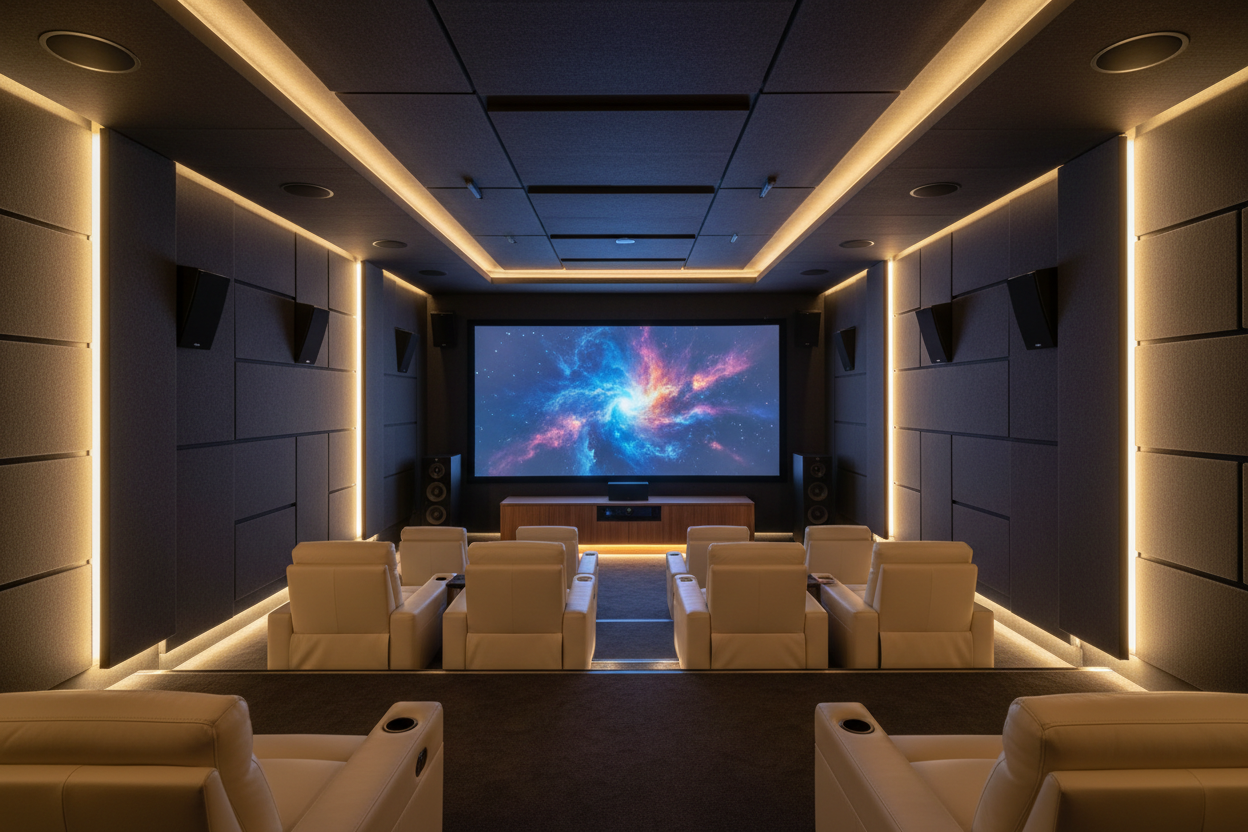
When people think about a “home theater,” they usually imagine a big screen, powerful sound, and the feeling of being completely immersed in a movie. That instinct is right — but a true home theater is more than just a large TV and loud speakers.
A home theater is a deliberately designed system that brings cinema-level sound and image into your own space. When it’s done correctly, it doesn’t just improve what you watch — it changes how it feels.
For some, a home theater is an upgrade from basic TV audio. For others, it becomes the centerpiece of their home — where movies, games, sports, and music all come alive in a more powerful way.
Wherever you’re starting from, the goal of a home theater is simple: to recreate the emotional impact of the cinema, at home.
What Exactly Is a Home Theater?
At its core, a home theater is a combination of three essential elements working together:
- A large, high-quality display (TV or projector)
- A multi-speaker surround sound system
- One or more media sources (streaming device, Blu-ray player, gaming console, etc.)
But what truly defines a home theater isn’t just the equipment alone — it’s the experience those components create together. A well-built home theater surrounds you with sound, fills your field of view with image, and pulls you into the moment in a way that ordinary TV setups simply can’t.
Unlike basic audio systems, a home theater is designed for immersion. Sound doesn’t just come from the front — it moves around you. Effects fill the space within the room. Explosions feel deeper. Dialogue gains more clarity. You feel present within the atmospheres.

Home Theater vs. Stereo System: What’s the Difference?
We often hear this question:
“If I already have a stereo system, do I really need a home theater?”
The answer depends on how you listen. .
A stereo system is designed primarily for music. It uses two speakers — left and right — to create a wide, detailed soundstage that excels at reproducing vocals, instruments, and musical balance. Stereo recordings are mixed specifically for this format, with all spatial information folded into two channels. When set up well, stereo delivers clarity, imaging, and tonal accuracy that remain the gold standard for music listening.
Home theater audio is built differently.
A home theater, by contrast, is built for motion and space. Modern films, shows, and games are mixed in 5.1 surround sound or higher, with dialogue, music, effects, and ambience placed across multiple speakers around the room, while a dedicated subwoofer handles low-frequency effects.
This separation allows sound to move front to back, side to side, and — in advanced formats like Dolby Atmos — above the listener, while bass adds the weight and physical impact that give cinematic sound its sense of scale and realism.
For a deeper explanation of surround sound formats and how they work, you can explore our dedicated guide to surround speakers and immersive audio formats.
This is the fundamental distinction:
- Stereo systems reproduce sound accurately
- Home theaters reproduce sound spatially
They’re not competitors — they’re different tools for different kinds of listening.
What Makes Up a Home Theater System?
A home theater is not a single product- it’s a system. Each component plays a specific role in shaping the experience.
Display: TV or Projector
Your display determines the visual scale of your home theater.
- Large TVs are the most common choice today. They’re bright, easy to install, and perfect for most living rooms.
- Projectors with screens are ideal if you want a true cinema-style image — especially in dark rooms where you can control lighting and acoustically perforated screens allow front speakers to be placed behind the image so dialogue stays perfectly aligned with the on-screen action.
Both approaches work exceptionally well.The right choice depends on your room size, lighting, and how immersive you want the experience to feel.
Audio System: Speakers, Subwoofer & AV Receiver
If the display is what you see, the audio system is what you feel.
- Speakers create the surround sound field — front speakers, a center channel for dialogue, and surround speakers for spatial effects. Together they place voices in the middle of the screen, anchor sound to what you’re watching, and let effects move around the room.
- Subwoofer handles deep bass — the low frequencies that give explosions weight, engines authority, and music physical presence. It complements and reinforces the bass that surround and main speakers are not designed to reproduce efficiently, allowing them to play cleaner and with less strain; without a capable subwoofer, movies and games lose scale and realism. A well-designed subwoofer like the SW15 is what gives your home theater that sense of scale and impact.
- AV Receiver or processor is the control center. It connects all your devices, decodes surround formats, and sends power and signals to each speaker. Think of it as the “brain” that keeps picture and sound in sync and makes sure every speaker plays the right part at the right time.
When these elements work together properly, the result is cohesive, controlled, and immersive sound — not just volume.
Source Devices
Your home theater needs content to come alive. This can include:
- Streaming devices
- Blu-ray players
- Game consoles
- Smart TV apps
- Media servers
These devices feed your system with the movies, shows, and games you love.
Why the Room Matters More Than Most People Realize
One of the biggest mistakes beginners make is focusing only on equipment. In reality, your room matters just as much.
Speaker placement, seating distance, wall reflections, ceiling height, and even furniture all affect how sound behaves. A well-tuned entry-level system in a good room often outperform an expensive system set up incorrectly.
Common Home Theater Speaker Layouts
Home theaters come in a variety of formats, giving you the flexibility to choose a system that fits your room, lifestyle, and viewing preferences. Here are the most common setups:
- 2.1 System – Two speakers and a subwoofer. Simple, compact, ideal for small spaces or living rooms where you want better sound than the TV, but don’t have room for multiple speakers around the sofa. A compact bookshelf speaker like the M1 fits this setup perfectly, delivering clean, detailed sound while enhancing your room’s design.
- 5.1 System – The standard surround setup with front, center, surround speakers and subwoofer. Most audio content is in this format.
- 7.1 System – Two additional rear speaker channels deliver a deeper sound field in larger rooms. With more speakers behind you, movement and directionality become more precise — great for dedicated media rooms or wide seating areas.
- Dolby Atmos Systems – Adds height speakers and additional surround channels to create soundscapes that immerse you from all angles. When set up properly, rain can fall from overhead, aircraft can pass above the screen, and the entire soundstage feels more three-dimensional.

For most people, a well-tuned 5.1 system delivers the best balance of immersion, practicality, and upgrade potential if the room is ready for expansion later.
Who Is a Home Theater Really For?
A home theater isn’t just for “audiophiles” or technical experts — it’s for anyone who wants to feel more connected to what they watch and play. Whether it’s the emotional weight of a film scene, the realism of a game world, the excitement of live sports, or the comfort of sharing a movie night with family, a home theater is designed to make those moments feel bigger, deeper, and more immersive.
Modern systems have been engineered to fit naturally into everyday life. It doesn’t matter if you’re in a compact apartment, a shared living room, or a dedicated media space — today’s home theater systems can be tailored to different lifestyles, volumes, and layouts. The goal isn’t to build a showroom; it’s to create an experience that feels personal, engaging, and easy to live with.
Can You Build a Home Theater in a Small Room or Apartment?
Absolutely.
Modern home theater systems are far more flexible than people expect. Compact speakers, efficient subwoofers, and smart tuning allow even small spaces to feel immersive.
The key is balance:
- Choosing speakers that match your room size
- Managing bass so it doesn’t overwhelm neighbors
- Positioning speakers correctly for clean sound at lower volumes
You don’t need a massive house to enjoy cinematic sound — you just need the right design.
Home Theater vs. Soundbar vs. Stereo System
If you’re trying to decide what direction to go, here’s the simplest breakdown:
-
Soundbar — A fast, simple TV sound upgrade with minimal setup. Designed as an all-in-one system, it uses multiple drivers and advanced acoustic engineering to project wider, clearer audio than built-in TV speakers, often simulating surround sound, all without adding extra boxes or wires.
-
Stereo system — Ideal for music lovers and minimal setups..
(If you’d like a deeper beginner-friendly explanation, you can explore our full guide here: What Is a Stereo System?.)
-
Full home theater — Best for movies, games, and total immersion, using multiple speakers and a subwoofer to create a cinematic experience.
Each option serves a different purpose. Many users even combine systems- a stereo system for music and a home theater for movies — to get the best of both worlds.
Common Beginner Mistakes
- Prioritizing power over clarity — louder isn’t always better
- Ignoring room acoustics and speaker placement
- Skipping the subwoofer and losing cinematic impact
- Buying systems that are too complex too early
- Expecting surround sound from stereo-only setups
True immersion requires dedicated surround channels, proper placement, and thoughtful tuning. Power alone cannot create a cinematic sound field.
As your system grows, acoustics become just as important as equipment. We’ll be exploring room acoustics, speaker positioning, and sound treatment in much more detail in future guides — because how sound moves in a space is what ultimately determines how real it feels.
Final Thoughts: Is a Home Theater Worth It?
A home theater isn’t about owning the most equipment. It’s about creating moments — the quiet tension before a scene explodes, the depth of a soundtrack, the realism of live sports, the excitement of a video game.
When built correctly, a home theater doesn’t just reproduce sound and image.
It creates presence.
If you’re starting your journey into cinematic sound, we believe a home theater can be one of the most rewarding upgrades you’ll ever make to your home.
And when you’re ready to take the next step, we’ll be here to guide you — from understanding the basics, to building a system that truly fits your space.
FAQ
1. Do I need a dedicated room to build a home theater?
No. A home theater can be integrated seamlessly into a living room, bedroom, apartment, or even a small space. With the right speaker size, placement, and volume control, you can create an entertainment experience without a dedicated cinema room.
2. What’s the difference between a soundbar and a full home theater system?
A soundbar is a simple, compact upgrade for TV audio. A full home theater uses multiple speakers, a subwoofer, and an AV receiver to create true surround sound and a much more detailed and precise audio experience.
3. Is a subwoofer really necessary for a home theater?
Yes. A subwoofer handles low frequencies that surround speakers may not be able to reproduce properly. It adds depth, impact, and physical presence to movies, games, and music — without it, the cinematic experience would be incomplete.
4. Can I start with a small system and upgrade later?
Absolutely. Many people start with a 2.0, 2.1 or 5.1 system and expand over time. A flexible setup allows you to upgrade speakers, add height channels, or improve room acoustics as your needs grow.
5. Is a home theater only for movies?
Not at all. While home theaters are excellent for movies, they’re also great for gaming, sports, concerts, and streaming shows. Many users enjoy both cinematic impact and everyday entertainment on the same system.
6. What’s the most important factor for good home theater sound?
There is no single factor that guarantees great sound — it’s the combination of proper equipment, careful placement, and room acoustics that makes the difference. Even high-end gear will underperform if the room is not set up correctly.
Share:
What Is a Stereo System? A Clear, Modern Guide for Better Home Sound
Surround Speakers: How to Place Them, Set Them Up, and Bring Your Room to Life