


When people imagine surround sound, they often imagine sound “coming from everywhere.”
Footsteps echoing behind. Rain falling around. A crowd swelling beyond the screen.
That instinct is right. Surround speakers exist to create space—sound that moves beyond the picture and fills the room itself.
Surround sound doesn’t happen automatically when speakers are plugged in. In real homes, the experience lives or dies in the details—where the speakers are placed, how they’re set up, and how they’re balanced with the rest of the system.

If you’re reading this, chances are you’re already past the basics. You’re not asking what surround sound is.
You’re asking how to make it sound right in your own room.
This guide approaches surround sound the same way a professional system would be built—methodically, intentionally, and with respect for how sound behaves in real spaces.
What Surround Speakers Actually Do
Surround speakers aren’t about volume.
They’re about space.
Their role is to shape everything that happens around the picture—the quiet movement behind a character, the echo of a large room, the tension created when something approaches from out of view, and the feeling that you’re inside the scene rather than watching it from the outside.
Surround speakers are not responsible for dialogue, low-frequency impact, or anchoring the front soundstage. Those roles belong to other speakers of the system. Effects created for delivery via Surround speakers complete the environment that the screen alone can’t convey.
When surround speakers are placed and tuned correctly, they complement the front speakers naturally, they don’t distract. You should simply feel that the room has depth, width, and life.
Where Surround Speakers Belong in Real Rooms
Placement is where surround sound either creates the soundscape environment around you—or collapses.
The 5.1 Layout (Most Homes)
In a typical 5.1 setup, you have five speakers and one subwoofer (it is the 1 in 5.1). For the other 5 speakers, there is the Left channel, Right Channel, Center Channel, Left Surround and Right Surround.The ideal placement is:
- Slightly beside or just behind your main listening position
- At an angle of about 90–110 degrees from the direction you’re facing
- Mounted a little above ear level, not directly at it
That small increase in height is important. Surround sound is meant to wrap around you, not shout directly into your ears.
When surrounds are mounted too low, the sound feels localized and distracting. Lift them slightly and the room opens up.
The 7.1 Layout (Larger Rooms)
A 7.1 system adds two additional speakers behind the seating area.
In this configuration:
- The side surrounds remain beside the listener
- The rear surrounds sit behind spaced apart
- All surround speakers remain slightly elevated
There is an important practical limitation here. If seating is placed directly against a back wall, a 7.1 system rarely performs as intended. There is not enough space for sound to develop behind the listener. In those situations, a properly placed 5.1 system almost always sounds better.
More speakers do not automatically mean better sound.

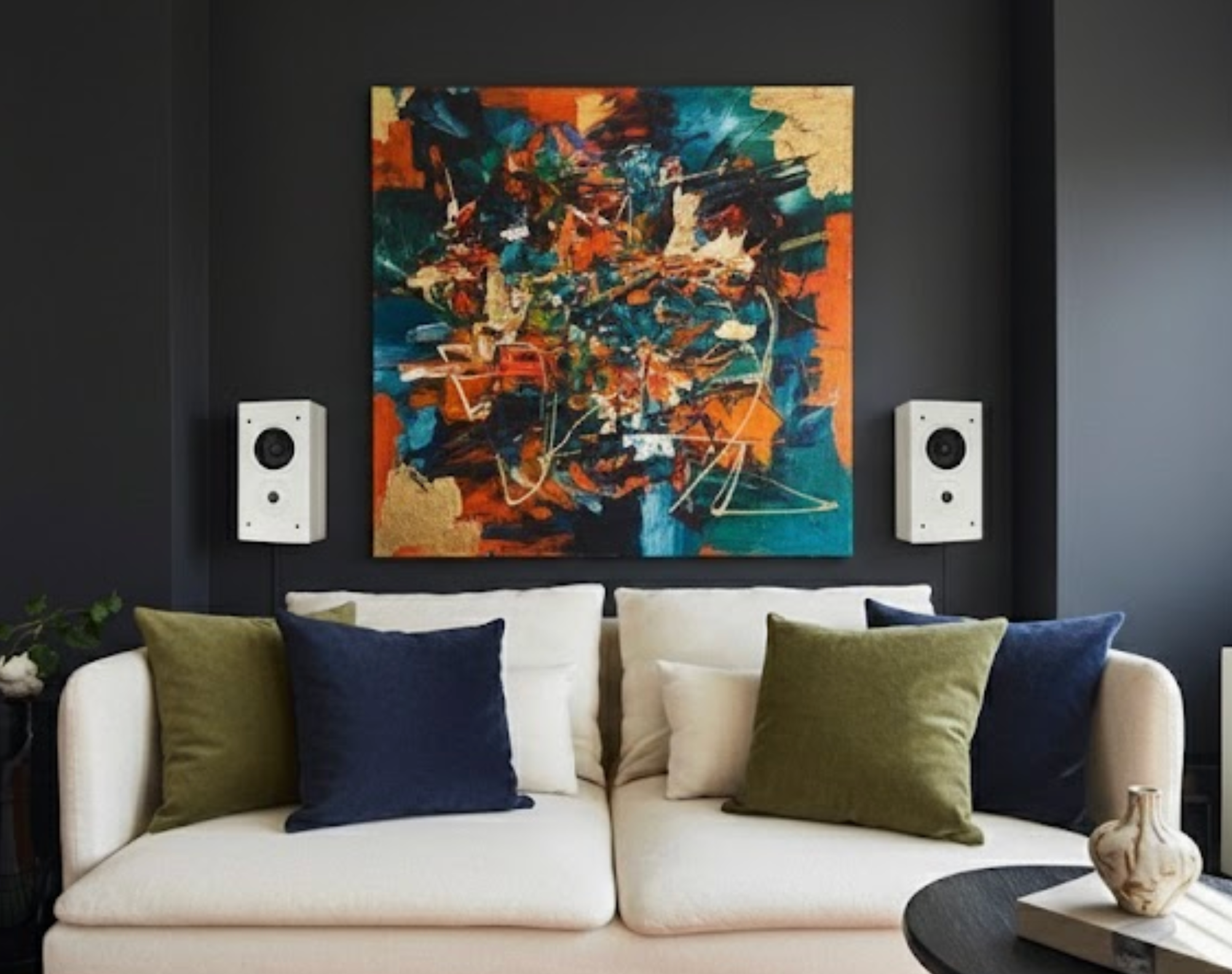
In rooms with limited space around the listening position, on-wall speakers can offer greater flexibility for proper surround placement without occupying floor space. Designed for immersive setups where seating is close to the rear wall, the Beta5W provides a clean, space-efficient solution while maintaining the tonal balance and dynamic performance expected from a high-fidelity system.
If you’re still mapping out the bigger picture—what actually qualifies as a home theater system and how the core components work together—our overview breaks it down here (what is a home theater)
Can Surround Speakers be Mounted on the Ceiling?
This is one of the most common questions in modern systems.
Ceiling speakers are excellent at what they are designed to do. As height channels in Dolby Atmos or other immersive formats, they add vertical movement—rain above you, aircraft overhead.
But they are not a replacement for traditional surround speakers.
Surround sound relies on horizontal movement around the listener.
Ceiling speakers create vertical movement above your head. These are different roles.
If you try to rely on ceiling speakers alone for surround effects, the sound often feels disconnected and unnatural. The room loses its sense of wrap-around space.
The most immersive systems use both:
- Surround speakers around the listener
- Height speakers above the listener
Each contributes to a different dimension to the experience.
Setting Up Surround Speakers: Where Systems Succeed or Fail
Purchasing speakers is straightforward.
Making them blend into the room is not. No matter how good your speakers are, surround sound only comes alive when the system is aligned and calibrated correctly. At the center of that process is one component.
The AV Receiver as the System’s Anchor
A proper AV receiver doesn’t just amplify sound—it orchestrates it.
True surround performance depends on the receiver controlling each channel with precision:
- Independent control of each output channel
- Accurate crossover settings
- Proper time alignment
- Level matching across the system
When these elements fall into place, the sound can then truly surround. Movement feels natural. Effects travel smoothly around you. Bass integrates seamlessly with the rest of the system.
When they are not—even slightly—the illusion breaks. Sound jumps, dialogue drifts, and the soundstage collapses.
This is why a television alone cannot create true surround sound, and why soundbars can only approximate it. Discrete speakers, managed by a capable receiver, remain the most reliable way to achieve convincing surround performance in real rooms.
A proper AV receiver doesn’t just amplify sound—it orchestrates it, managing channel routing, timing, and balance across the system.
In higher-performance installations, that control is often paired with dedicated external amplification. For a real-world example of the kind of power and channel precision such systems demand, the Fiera8 multichannel amplifier is designed specifically for reference-grade home-theater environments. We will dedicate a full guide in the future to walk through how to calibrate an AV receiver step-by-step—so every channel performs exactly the way it was designed to, stay tuned!
Crossover: Where Your Surround Speakers Meet the Bass
Most surround speakers perform best with a crossover between 80 and 120 Hz.
This means:
- Below that point, sound is routed to the subwoofer.
- Above it, the surround speakers handle detail and ambience.
If the crossover is set too low, small speakers are asked to reproduce bass frequencies that exceed their mechanical and acoustic limits, increasing distortion and reducing clarity.
If it is set too high, too much lower-frequency energy is redirected to the subwoofer, making bass easier to localize and weakening midbass presence, which reduces overall cohesion.
For most systems, 80–100 Hz remains the most natural balance.
Level Matching: Presence Without Distraction
Surround speakers should support the experience, not compete with it.
If they’re too loud, your attention gets pulled away from the screen.
If they’re too quiet, the room collapses into a flat, front-heavy soundstage.
The goal is balance. You should feel the space long before you consciously notice the speakers.
Distance Settings: Why Timing Matters
Every AV receiver requests for the distance from each speaker to your listening position. This information controls timing.This matters more than many people realize.
If distances are inaccurate, sound arrives at different moments. Movement feels uneven. Dialogue and effects lose cohesion.
Taking the time to measure distances carefully is one of the simplest and most effective upgrades of any system.
Surround Speakers vs. Stereo Speakers
It’s easy to assume that any speaker can be placed anywhere in a system—but surround speakers and stereo speakers are designed with completely different intentions.
Surround speakers emphasize wide dispersion and smooth off-axis response, allowing sound to blend into the room and wrap around the listener.
Stereo speakers, on the other hand, are built for focus. They emphasize front-stage imaging, precise left-right placement, and the kind of clarity that anchors vocals and instruments. (If you want a deeper beginner-friendly explanation of how stereo imaging works, you can explore our full guide here: What Is a Stereo System?.)
Using large, forward-firing stereo speakers as surrounds often produces aggressive, localized rear sound. Instead of expanding the environment, the speakers call attention to themselves.
The most successful surround systems are the ones where the speakers themselves fade from awareness, and the room becomes the soundstage.
Common Surround Speaker Mistakes
We see the same issues again and again:
- Surrounds mounted too low
- Surrounds installed in front of the listener
- Ceiling speakers used as the only surround channels
- Surround volume level set too high
- Distance and delay left uncalibrated
- Small speakers forced to reproduce excessive bass
Any one of these can weaken the experience. Several combined can completely flatten it.
Do You Actually Need Surround Speakers?
Surround speakers are not for every room or every listener. But when the conditions are right, they are transformative.
If movies are a regular part of your life, if you’re drawn to story-driven or cinematic games, if your seating isn’t pressed tightly against every wall, and if your system already includes a center speaker and a subwoofer, then surround speakers won’t be an experiment for you—they’ll be a transformation.
In rooms like these, surround sound doesn’t feel like an upgrade; it feels like the way the system was always meant to work. And once you experience a properly placed surround system in a space that allows it to breathe, returning to front-only sound can feel surprisingly limiting.
Surround Sound Is About Space, Not Loudness
Surround speakers don’t exist to make your system louder.
They exist to make sound feel real.
They give scenes dimension.
They allow sound to move naturally.
They turn listening into an environment rather than a direction.
Surround speakers are one of the foundations of immersive audio in real rooms. They create the space that later technologies build upon. In future guides, we’ll go deeper into how immersive audio works, how it differs from traditional surround sound, and how you can shape it to fit your own space.
When it’s done right, surround sound doesn’t pull attention to the speakers themselves. It allows you to feel inside the story, not just in front of it.
When surround speakers are placed correctly and tuned with care, they disappear—
and the room itself becomes the instrument.
If your goal is a home theater that feels cinematic rather than simply louder than the TV, surround speakers aren’t an accessory.
They’re a foundation.
FAQ
1. Do I really need surround speakers?
If you watch movies or play cinematic games regularly, they make the experience dramatically more immersive.
2. How high should surround speakers be placed?
About 10–30 cm (4–12 inches) above ear level for the best wrap-around effect.
3. Can ceiling speakers replace surround speakers?
No. Ceiling speakers create height effects, not horizontal surround movement.
4. What crossover should I use for surround speakers?
Most systems sound best between 80–100 Hz.
5. How do I know my surround levels are correct?
You should feel the space—not hear the speakers calling attention to themselves.
6. Do I need Atmos if I already have surrounds?
Not required, but Atmos adds vertical dimension. Add it later if you want full immersive audio.
Share:
What Is a Home Theater? A Beginner’s Guide to Building a Cinema Experience at Home
Understanding Bookshelf Speakers Under $500: Why Starke Sound Beta5 Is the New Reference