


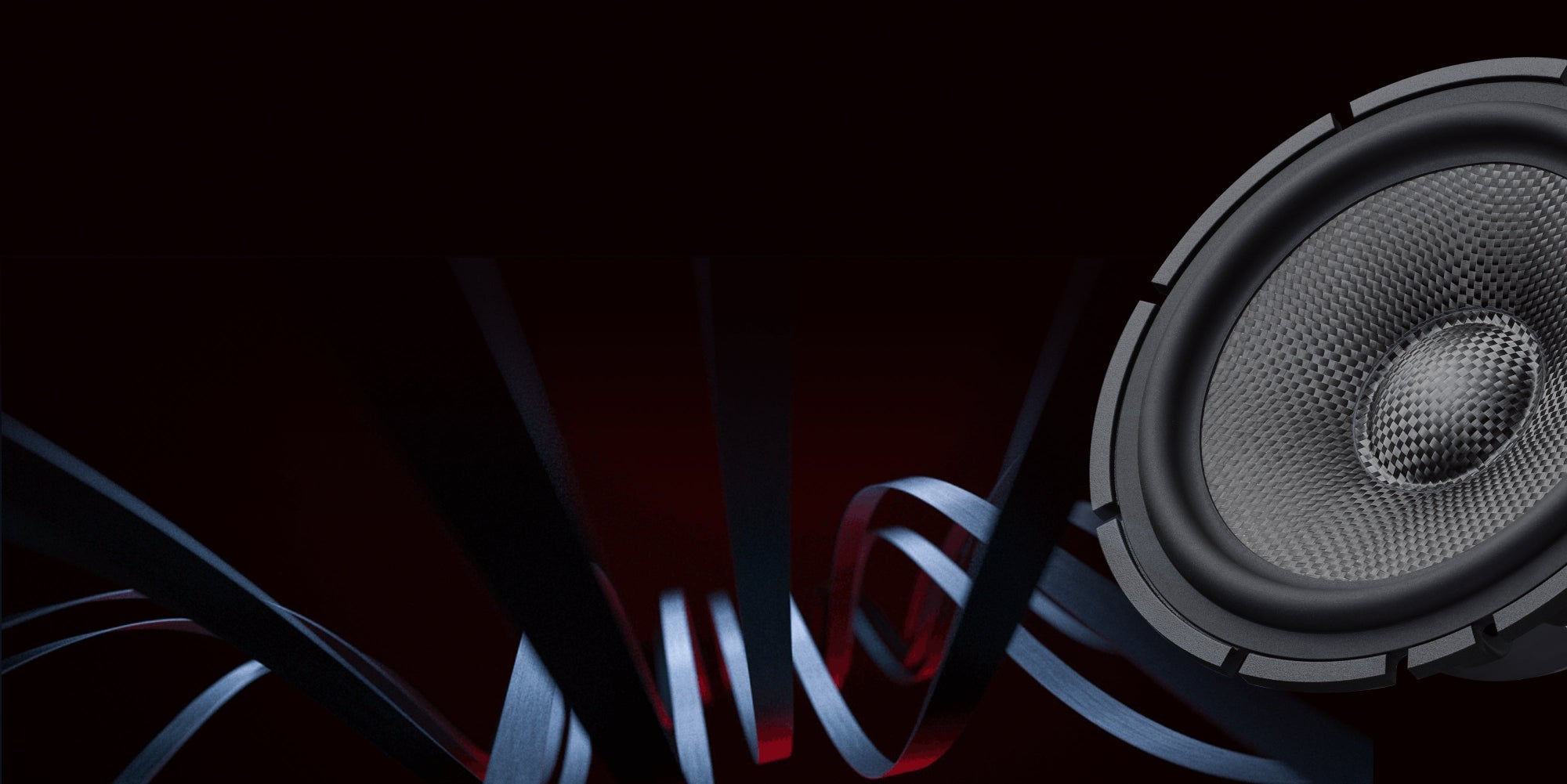
In the pursuit of high-fidelity sound, many believe Neodymium Magnets are the only answer, but the traditional bookshelf speaker has always been a compromise. Physicists tell us that to move significant air at low frequencies, you need surface area (large woofers) or massive excursion (long-throw motors).
For decades, the limit of the "small speaker" was defined by the physical constraints of the ferrite magnet—the heavy, bulky, and relatively weak ceramic motor that powers 90% of the industry.
However, for the experienced audiophile, the transition from Ferrite to Neodymium Magnets isn't just about saving weight. It is about a fundamental shift in magnetic flux density and motor control. At Starke Sound, we’ve taken this a step further with our proprietary HEMF (Hybrid High-Efficiency Motor System) technology.
Originally developed for our premium Brio series (VS family) and now driving the highly acclaimed Beta family (including the Beta5), this architecture proves that a compact 5.25-inch driver can achieve reference-grade performance that defies its footprint.
The Power of Neodymium Magnets: Beyond the "Rare Earth" Hype
A neodymium magnet (NdFeB) is capable of generating a magnetic field significantly more intense than a traditional ferrite magnet of equal size. In loudspeaker design, this intensity is measured as Magnetic Flux Density ($B$).
For an audiophile, $B$ is the "grip" the motor has on the voice coil. When you increase the magnetic strength in the gap, you increase the $BL$ product (Force Factor). This results in:
- Instantaneous Transient Response: The ability of the cone to start and, more importantly, stop exactly when the signal dictates.
- Higher Sensitivity: Converting electrical energy into acoustic pressure with minimal loss.
- Massive SPL in Small Enclosures: This is how the Starke Sound Beta5 achieves a staggering 108dB max SPL. Without the energy density of Neodymium Magnets, a 5.25-inch driver would reach mechanical compression long before hitting those cinematic peaks.
Neodymium vs. Ferrite: The R&D Story Behind HEMF
While neodymium is a "super-magnet," seasoned hobbyists know it has a weakness: thermal sensitivity.
When our engineering team first began developing the transducers for the Brio series (VS family), our initial prototypes utilized pure Neodymium Magnets. The sheer acoustic power and sensitivity were intoxicating. However, during rigorous stress testing, we hit a wall. In a compact chassis, the intense heat generated by continuous, high-SPL playback caused the pure neodymium motor to suffer from thermal compression.

Furthermore, we faced a physical and economic paradox. To achieve extreme flux density using pure ferrite, the magnet would need to be massively huge and heavy, making it impossible to fit inside a sleek cabinet. Conversely, using pure, high-temperature-grade neodymium to achieve the same stability would drive the cost to astronomical levels. We also noticed that without proper magnetic shaping, the raw brute force of pure neodymium could result in an asymmetrical field, leading to slightly harsh, fatiguing sound at maximum volume.
We needed a solution that offered the explosive dynamics of neodymium, but with the rock-solid thermal stability, smooth linearity, and practical footprint of traditional designs. This realization led to the creation of the Starke Sound HEMF technology—a design that has now become the universal motor architecture for our mid-tier and premium lines.
The Four Pillars of the HEMF Architecture
Instead of choosing one material, our patented HEMF design utilizes a Hybrid Compound Magnet System. By pairing a high-grade Ferrite outer ring with a powerful Neodymium inner core, we achieve four distinct architectural advantages:
1. Massive Boost in Sensitivity & Transients (The Neodymium Advantage)
Because Neodymium Magnets provide an incredibly intense Magnetic Flux Density ($B$), the electromagnetic force exerted on the voice coil in the gap is drastically increased. This higher $BL$ product (Force Factor) makes the speaker much easier to drive, yielding higher SPL at the same wattage. More importantly, it gives the motor "absolute grip" over the cone, enabling an instantaneous transient response—perfect for the lightning-fast micro-dynamics of gunshots and explosions in home cinema.
2. Ultimate Thermal Stability (The Ferrite Advantage)
At concert-level volumes, voice coils generate extreme heat. If pure neodymium gets too hot, its magnetic force fades (thermal compression), causing the dynamics to "squash." In the HEMF system, the bulky Ferrite ring isn't just a secondary magnet; it acts as a massive physical Heat Sink. It rapidly absorbs and dissipates the heat generated by the voice coil and the neodymium core. Because ferrite is inherently heat-resistant, the motor maintains stable magnetic flux during long, heavy-duty listening sessions without ever sounding "soft."
3. Symmetrical Magnetic Field for Ultra-Low Distortion (The Hybrid Advantage)
In traditional single-magnet designs, the magnetic field is rarely perfectly symmetrical across the front and back of the gap. When the voice coil pushes forward or pulls backward during large excursions, uneven force creates non-linear harmonic distortion. The HEMF geometry solves this by using the ferrite ring to constrain and shape the magnetic lines of the neodymium core. This creates a highly uniform, perfectly symmetrical magnetic gap. Whether the cone is moving inward or outward, the push/pull forces remain exactly equal, resulting in pure, fatigue-free audio.
4. The Perfect Balance of Size, Weight, and Cost
The HEMF architecture uses a relatively small amount of neodymium for explosive core power, backed up by low-cost ferrite for thermal mass and magnetic shaping. This hybrid approach controls the overall weight and depth of the driver (allowing for better cabinet design) while keeping manufacturing costs reasonable. It transforms expensive reference-level performance into extreme value.
Solving the "Small Speaker" Bass Paradox
The most common prejudice in Hi-Fi is that "small speakers can't do real bass." Physically, to get deep bass from a small cone, the voice coil must travel a long distance ($Xmax$) without leaving the magnetic "sweet spot."
In a cheap ferrite motor, the magnetic field drops off rapidly and asymmetrically as the coil moves away from the center, causing Intermodulation Distortion (IMD)—where heavy bass notes muddy the midrange vocals.
Because the HEMF motor utilizes the density of Neodymium Magnets combined with the symmetrical shaping of the Ferrite ring (Advantage #3), the voice coil remains under "absolute grip" even at maximum extension. This allows a speaker like the Beta5 to reach down to 45Hz with the tight, "fast" bass usually reserved for large-format towers, all while keeping the critical midrange frequencies pristine and uncolored.
The New Reference in Motor Engineering
Neodymium Magnets are the engine, but the Hybrid High-Efficiency Motor System is the transmission that makes that power usable, stable, and musical. From its origins in the Brio series to its current implementation in the Beta5, HEMF eliminates the "flaws" typically associated with compact transducers.
We didn't just build a better bookshelf speaker; we re-engineered the physics of the motor to ensure that force, heat, linearity, and cost are no longer obstacles to your music.
Technical FAQ
1. Why use a hybrid HEMF motor instead of pure Neodymium Magnets?
During the development of our Brio series, we found pure neodymium can suffer from thermal compression and non-linear distortion at extreme volumes. The hybrid HEMF design adds a Ferrite ring to act as a heat sink and shape the magnetic field for superior linearity and fatigue-free listening.
2. How do Neodymium Magnets improve bass in a small speaker?
They provide an incredibly dense magnetic flux. When symmetrically shaped by our HEMF technology, this gives the motor absolute control over the voice coil during the long-throw excursions required for deep 45Hz extension.
3. Does the HEMF architecture affect the clarity of vocals?
Yes. By maintaining a perfectly symmetrical magnetic gap, it drastically reduces Intermodulation Distortion (IMD), ensuring that heavy bass notes do not "muddy" the delicate midrange frequencies.
4. What is the benefit of the 108dB max SPL in the Beta5?
It indicates massive dynamic headroom. Driven by the HEMF system, the speaker can handle sudden orchestral peaks or cinematic explosions without the mechanical or thermal compression typical of standard motors.
5. Are neodymium speakers more sensitive to heat?
Standard Neodymium Magnets can lose magnetic strength at high temperatures. However, the HEMF architecture solves this by using the massive Ferrite ring to absorb and dissipate heat, maintaining absolute magnetic stability.
6. Does the magnet type affect the "speed" of the sound?
Absolutely. The high flux density of neodymium enables an instantaneous transient response, meaning the driver's cone starts and stops with pinpoint precision.
7. Is a 5.25-inch driver large enough for high-fidelity listening?
When powered by a high-efficiency hybrid motor like the HEMF system, a 5.25-inch driver overcomes traditional physical limits, moving air with the scale, detail, and authority of much larger speakers.
Share:
Ceiling Speakers Guide: The Final Piece of Immersive Sound
Beyond the Numbers: Understanding Frequency Response in High-End Audio